
Choosing an ATPL theory course is not simply a question of where you prefer to sit and study. The decision between distance versus classroom ATPL affects how you manage your time, access instructors, build exam discipline and fit demanding theoretical knowledge training around work, family or an existing flying career. The right route is the one that gives you enough structure to perform at your best, without creating unnecessary barriers to consistent study.
For many aspiring airline pilots and ICAO licence holders converting to EASA, distance learning now provides a serious, regulated and highly effective route. Classroom tuition still has clear strengths too. The meaningful comparison is not online versus in-person in isolation. It is the quality of the learning design, the expertise of the instructors, the support available when a subject becomes difficult, and your own ability to study independently.
Distance versus classroom ATPL: the core difference
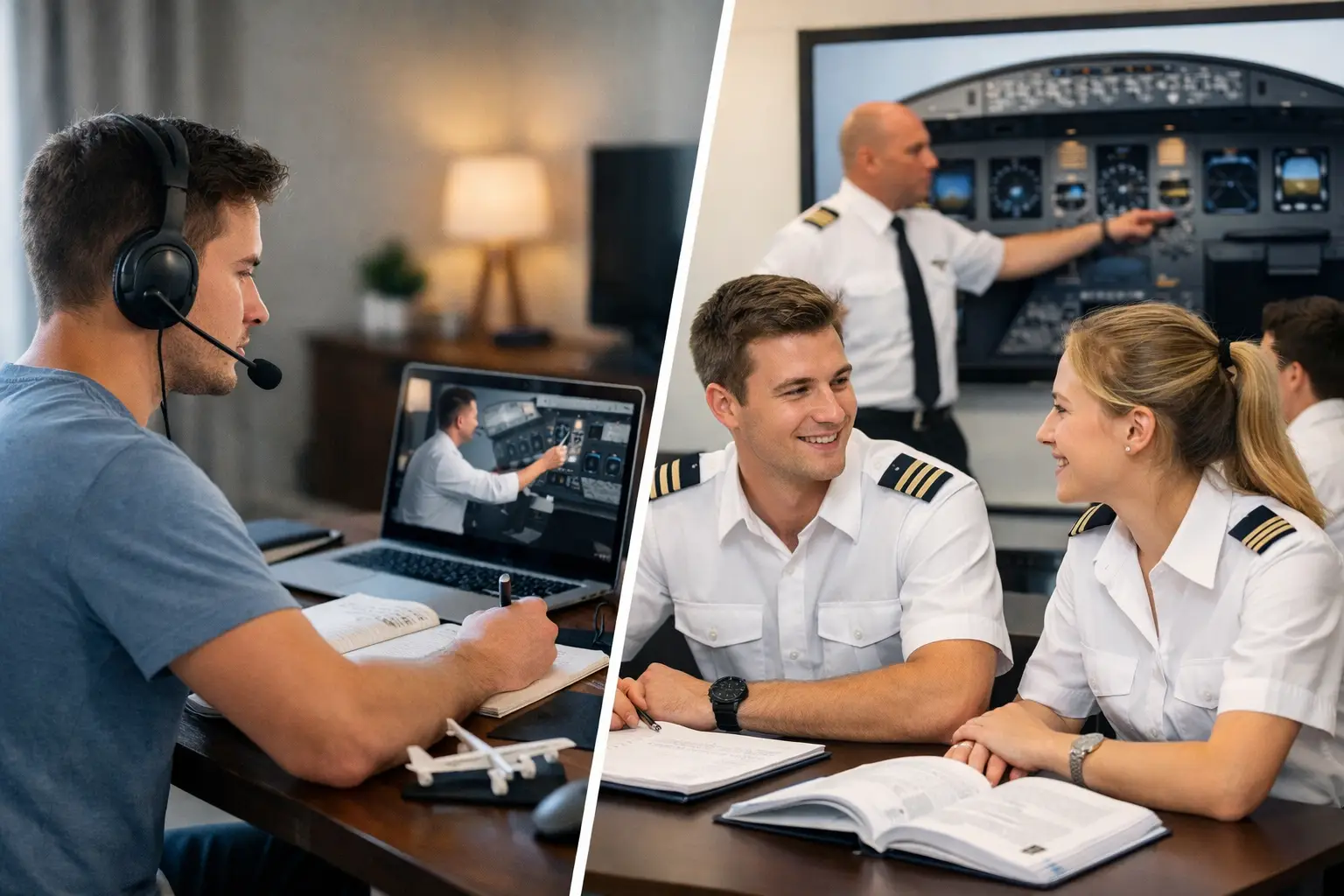
A classroom ATPL course places most teaching at fixed times and in a physical training environment. Students progress through a timetable of instructor-led lessons, revision sessions and assessments alongside a cohort. This can create welcome momentum. You arrive, focus on the subject in front of you and benefit from immediate discussion with instructors and fellow students.
Distance ATPL training delivers the programme through an approved digital learning environment. Students work through structured subject material, video instruction, knowledge checks, practice questions and ATO assessments from wherever they are based. They still follow an approved course and must meet defined progress and assessment requirements, but they can usually determine when and where much of their learning takes place.
A blended course sits between the two. It combines online study with scheduled classroom tuition, often for intensive teaching or revision. For some students, this offers a useful balance. However, it is worth checking whether travel is genuinely necessary for the course or whether a fully remote pathway can provide the same academic support with greater flexibility.
When distance ATPL study is the stronger choice
Distance learning is particularly well suited to students whose professional or personal commitments do not fit a conventional weekday timetable. A pilot working abroad, an aviation professional on rostered shifts or an international student preparing for EASA examinations may find that travelling to a training centre for weeks at a time is impractical and expensive.
The best online programmes do more than upload reading material. They create a clear learning pathway through each ATPL subject, with specialist-led teaching, planned milestones, progress monitoring and responsive academic support. This matters because ATPL theory is broad and interconnected. Performance, Flight Planning, Meteorology, Principles of Flight and Air Law each require different ways of thinking. Students need to know not only what to study next, but why a concept matters in an operational setting.
Flexibility also allows students to spend time where they need it most. A candidate already comfortable with mathematical calculations may move efficiently through familiar material, while allocating additional time to areas such as Mass and Balance, radio navigation or the practical application of operational procedures. In a fixed classroom timetable, the pace is naturally set for the group.
Distance study can also improve revision quality when sessions are recorded or available as on-demand masterclasses. Replaying an explanation of a performance calculation, a weather chart or a flight planning principle is not a shortcut. It is a practical way to turn a difficult first encounter into secure understanding.
That said, flexibility is only valuable when it is supported by routine. Students who thrive remotely tend to treat study appointments as fixed commitments, set realistic weekly targets and act early when they identify a gap in their knowledge. The ability to study at any time can become a disadvantage if it turns into studying only when time happens to appear.
What classroom ATPL training does well
Classroom training can be an excellent option for students who learn best through live interaction and an externally imposed routine. A timetable removes daily decisions about when to begin. For someone who finds independent study difficult, that structure can be decisive.
There is also value in the immediacy of a well-run classroom. An instructor can see when a group is struggling, adjust an explanation, work through a calculation on the board and answer follow-up questions in the moment. Discussions with other students can expose alternative ways of approaching a problem and make intensive revision feel less isolating.
A classroom environment may suit candidates who can dedicate a defined period entirely to ATPL theory. If travelling and accommodation are manageable, and you prefer to separate study from home or work, attending in person can create a focused learning period with fewer competing demands.
But classroom attendance does not automatically guarantee better results. The pace may feel too fast in some subjects and too slow in others. Missing a lesson due to work, illness or travel can create pressure to catch up. It can also be costly for students based outside the training location. The course is only as effective as the instruction, the supporting digital resources and the individual effort that continues after the class finishes.
The issue is not location, but learning quality
A strong distance ATPL course should not ask students to work alone with a question bank. It should provide a complete and compliant training experience: carefully sequenced material, expert teaching, monitored progression, formal assessments and direct access to people who can explain the subject properly.
Instructor specialism is especially important. ATPL theory becomes more useful and easier to retain when it is taught by people with current, relevant operational insight. A lesson on meteorological decision-making should connect atmospheric theory with the operational consequences for a flight. A discussion of flight planning should clarify how calculations, limitations, fuel policy and route considerations interact in practice. This is how knowledge develops beyond memorising answers.
Digital learning also makes support more traceable and accessible. A student should be able to ask a focused question, revisit the answer, contribute to a discussion forum and see their progress against the course plan. For international learners, this can be more practical than waiting for the next classroom session in a different time zone.
As the premium EASA ATPL theory specialist, ASG combines remote learning pathways with industry-specialist instruction, structured assessments and a dedicated Learning Centre designed to keep students connected to their progress and to expert support. The aim is not to make ATPL theory easier than it is. It is to make high standards achievable from anywhere.
How to decide which ATPL route suits you
Start with your real circumstances rather than an idealised study plan. If you have predictable full-time availability and prefer face-to-face teaching, classroom or blended study may give you the routine you need. If you work shifts, live internationally or need to maintain professional commitments, a fully remote course may be the more sustainable option.
Next, assess your study habits honestly. Can you protect regular study time without being told to attend a lesson? Do you ask for help promptly rather than letting uncertainty build? If the answer is yes, distance learning can be highly effective. If not, look for an online provider that includes clear milestones, scheduled support and progress accountability, or consider a course with classroom elements.
Then examine the training provider rather than relying on the delivery label. Confirm that the course is delivered by an EASA Approved Training Organisation, understand how ATO assessments are managed, and ask what happens if you fall behind in a difficult subject. Look for subject-specific instruction, not generic tuition. Ask whether teaching is available on demand, whether progress is monitored and how quickly students can receive a meaningful academic response.
Finally, think about exam preparation from the beginning. EASA ATPL examinations test breadth, accuracy and the ability to apply knowledge under time pressure. A useful course builds towards that outcome through guided learning, purposeful revision and properly timed practice, rather than leaving exam technique until the final weeks.
A practical way to make either route work
Whichever route you choose, create a weekly plan that includes new learning, consolidation and question practice. Do not spend every available hour answering questions before you understand the underlying theory. Question banks are valuable for identifying weak areas and building examination discipline, but they cannot replace instruction and active revision.
Use performance data intelligently. Repeated errors in a topic are useful evidence, not a reason to keep guessing. Return to the relevant lesson, work through the principle slowly and seek an instructor explanation where required. This habit is particularly valuable in calculation-heavy or regulation-based subjects, where a small misunderstanding can produce a pattern of wrong answers.
The best choice is the route that lets you study consistently, receive expert guidance and arrive at each examination with genuine confidence in the material. Choose structure if you need structure. Choose flexibility if flexibility protects your momentum. Then commit to a course experience that treats your ATPL theory as preparation for professional operational responsibility, not merely a set of exams to pass.