

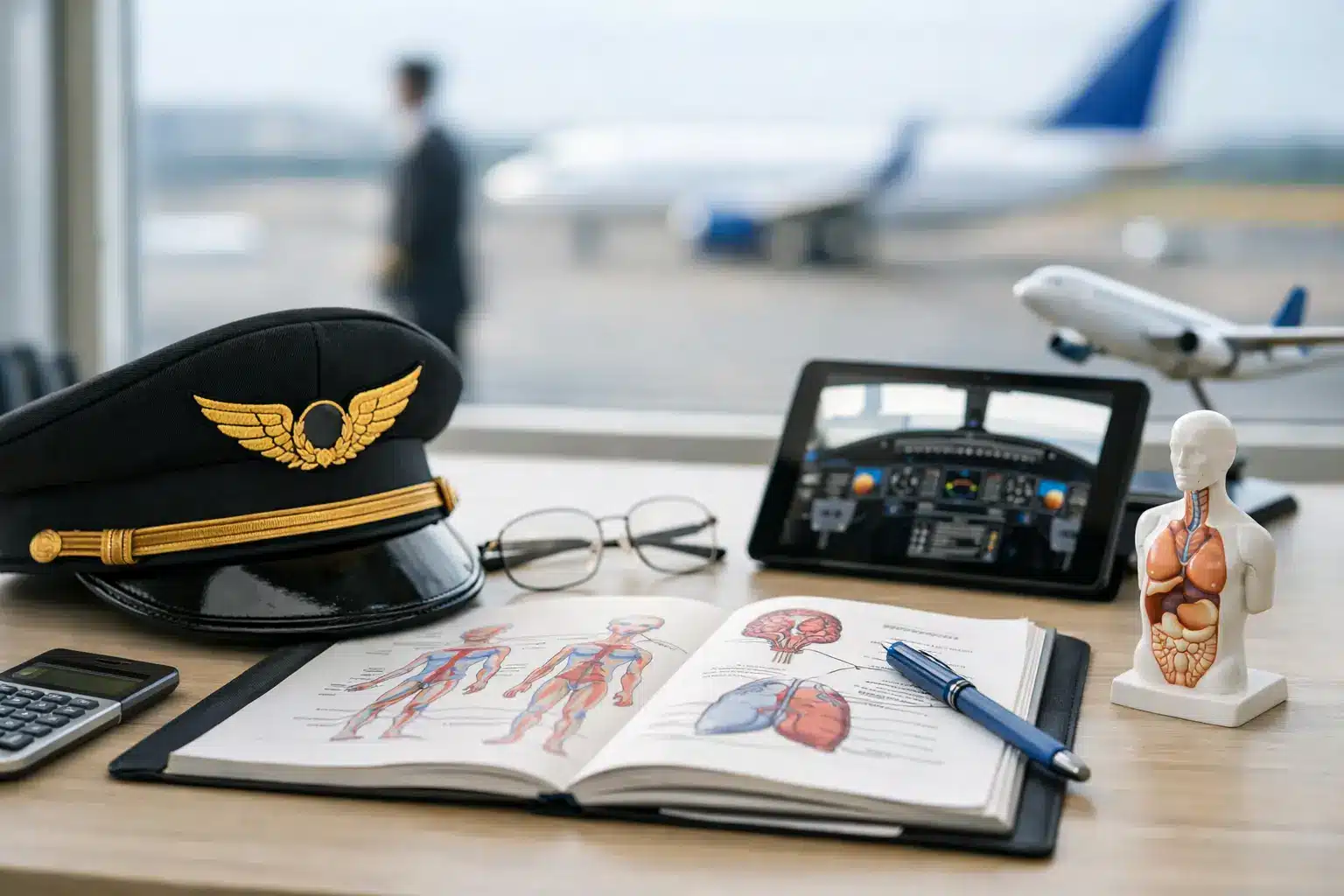
A pilot can understand every system on the flight deck and still make a poor decision when tired, rushed, overloaded or reluctant to challenge a colleague. That is why human performance exam essentials deserve more than last-minute memorisation. For EASA ATPL students, Human Performance and Limitations explains the people behind aviation safety: how pilots perceive, decide, communicate, cope with pressure and manage their own limitations.
The subject can appear deceptively straightforward because much of it feels familiar. We all know that fatigue is harmful and communication matters. The examination tests whether you can distinguish related concepts, apply them to an operational situation and recognise why an apparently sensible action may increase risk. Strong preparation means learning the mechanisms, not just remembering isolated facts.
Why Human Performance Matters in ATPL Theory
Human Performance and Limitations is not separate from airline operations. It sits behind effective crew cooperation, threat and error management, safe decision-making and the disciplined use of procedures. A technical fault may begin a problem, but an accident chain often develops through human factors: an incomplete briefing, a missed cue, a rushed response or an assumption left unchallenged.
The ATPL examination therefore asks students to understand performance in context. A question about vision is not only about the anatomy of the eye. It may concern why a pilot misjudges distance at night, fails to detect another aircraft, or becomes vulnerable to visual illusions during an approach. A question about stress is not simply asking for a definition. It may test whether performance improves or deteriorates as workload rises, and why the answer depends on the individual, the task and the conditions.
This operational context is also what makes the subject valuable later. Airline crews work within tightly managed procedures, but procedures are performed by people. Knowing where human performance can degrade helps pilots build habits that protect the operation before margins narrow.
Human Performance Exam Essentials to Know
A productive revision plan starts by organising the syllabus into connected themes rather than treating it as a long list of terms. The most examinable areas repeatedly link physiology, psychology and operational behaviour.
Physiology: Know the Effect, Cause and Operational Risk
Students should be able to explain how the body responds to the flight environment and why that response matters to performance. Hypoxia, hyperventilation, decompression, motion sickness, fatigue, sleep, alcohol, medication and sensory limitations all require more than a definition.
For each topic, ask three questions: what happens in the body, what symptoms or performance effects may follow, and what action is appropriate? This approach is particularly useful where symptoms may be misleading. For example, hypoxia can impair judgement while creating a false sense of wellbeing. A pilot who does not recognise that risk may delay corrective action precisely when clear thinking is most needed.
Be precise with distinctions. Hypoxia and hyperventilation may both produce symptoms such as dizziness or tingling, yet their causes and responses differ. Similarly, acute fatigue after restricted sleep is not identical to circadian disruption, even though both can reduce alertness and decision quality.
Psychology: Understand How Decisions Go Wrong
The psychology section covers attention, perception, memory, workload, stress, attitudes, motivation and decision-making. These subjects are closely connected. High workload can reduce spare attentional capacity; reduced attention can lead to missed information; missed information can then distort a decision.
Memory is a common example. Sensory, short-term and long-term memory have different characteristics and vulnerabilities. In operational terms, a clearance heard during a busy phase of flight may be forgotten or confused if it is not properly encoded, cross-checked or supported by standard procedures. The lesson is not that pilots must possess perfect memories. It is that professional operations use checks, call-outs and written aids because human memory has limits.
Stress requires nuance. A moderate level of arousal may sharpen performance on a familiar task, while excessive stress can narrow attention, disrupt judgement and encourage fixation. There is no single workload threshold that applies equally to every pilot or every situation. Exam questions may use this principle to test whether you can reject absolute statements.
Vision, Hearing and Spatial Orientation
Sensory limitations are highly relevant to aviation because pilots often operate with incomplete or ambiguous information. Revise the physiology of vision, including the role of central and peripheral vision, adaptation to darkness, visual acuity and colour perception. Then connect that knowledge to night operations and visual illusions.
Spatial disorientation deserves particular care. The vestibular system can create convincing but inaccurate sensations of movement or attitude, especially without a reliable external visual reference. The safe operational response is not to trust the sensation more strongly. It is to recognise its limitations and rely on the appropriate flight instruments and procedures.
Hearing is similarly practical. Noise can interfere with communication, increase fatigue and mask important cues. The examination may test the effect of noise on performance as well as basic hearing function.
Communication, CRM and Group Behaviour
Human Performance questions frequently examine what happens when people work together. Effective communication is not merely speaking clearly. It involves transmitting an accurate message, confirming it has been understood and creating an environment where concerns can be raised early.
Authority gradients are a good example. A clear command structure is necessary, particularly in abnormal operations, but an excessive gradient can discourage a less senior crew member from questioning an unsafe action. The most effective crews balance leadership with constructive challenge. They use standard phraseology, brief clearly, monitor one another and resolve uncertainty before it becomes an error.
Group behaviour can also produce conformity, diffusion of responsibility and pressure to continue with an original plan. These are not character flaws. They are predictable human tendencies, which is why professional crews use structured decision-making and cross-monitoring.
A Better Way to Revise Human Performance
Reading a chapter repeatedly can create familiarity without proving recall. Human Performance rewards active revision because many concepts are similar on the surface. Build concise comparison notes for topics that are easily confused, such as stress versus fatigue, attention versus perception, and hypoxia versus hyperventilation.
Use scenario questions to test application. Rather than asking only, “What is fixation?”, ask what a crew member is likely to miss when attention becomes fixed on one malfunction during a high-workload phase. This makes the definition easier to retain because it has an operational consequence.
A useful revision sequence is to study the underlying principle, explain it aloud in plain language, answer focused questions, then review every incorrect answer by identifying why the alternative options were wrong. The final step matters. Incorrect options often expose a misunderstanding caused by an absolute word such as “always”, a reversed relationship, or two concepts being blended together.
Keep an error log during question practice. Record the topic, the reason for the error and the corrected rule in one or two lines. Over time, the log becomes a targeted revision resource rather than a record of failures. Students balancing theory with work particularly benefit from this approach, as short, deliberate sessions are usually more effective than occasional long revision days.
How to Handle the Exam Questions
Read the stem before looking for familiar keywords in the answer choices. Human Performance questions often test qualifiers, conditions and cause-and-effect relationships. If a statement seems broadly true, check whether it is true in every circumstance described.
Eliminate answers that confuse a symptom with a cause, or a mitigation with a cure. A procedure may reduce the likelihood of an error without removing the underlying limitation. For instance, a checklist supports memory, but it does not make workload, fatigue or distraction irrelevant.
When two answers seem plausible, return to the operational purpose of the concept. Ask which option best reflects safe professional practice and the underlying human factor. This should not replace syllabus knowledge, but it is an effective check against answers that sound reasonable while contradicting established principles.
Avoid turning Human Performance into a collection of dramatic accident examples. Real events can make a concept memorable, but the examination requires controlled understanding of the principle itself. Learn the terminology accurately, then use operational examples to give it meaning.
Turn Knowledge into Professional Judgement
The strongest students do not revise Human Performance as a stand-alone hurdle between them and an ATPL theory pass. They recognise it as the subject that explains why disciplined routines, good communication and personal wellbeing remain central even when technology is highly capable.
At ASG, the premium EASA ATPL theory specialist, this connection between technical knowledge and real operational practice is central to effective learning. Specialist instruction can help students see why a principle matters, while structured digital revision makes it easier to identify and close gaps before an ATO assessment or authority examination.
Give this subject the same respect you would give performance calculations or systems knowledge. Each revision session is an opportunity to practise a professional habit: recognise a limitation early, use the right safeguard and make the safer decision before pressure takes control.